
Is Rolfing Massage Therapy?

Updated: Jan 17
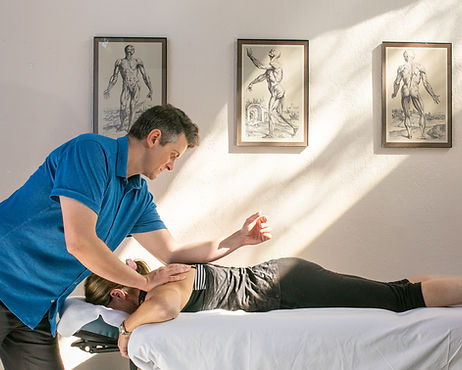
People often ask whether Rolfing is a form of massage therapy, and it’s a reasonable question. Rolfing is hands-on, therapeutic, and often practiced by licensed massage therapists. From the outside, it can look similar to other forms of bodywork people are already familiar with.
The short answer is that Rolfing isn’t massage therapy in the conventional sense, but it does belong to the same broader tradition of hands-on therapeutic work. Understanding why requires a bit of context. Read more about Rolfing here.
Rolfing and Massage Therapy
Rolfing and massage therapy share real overlap. Both involve skilled hands-on contact with the body. Both are commonly sought out for pain, discomfort, restricted movement, or a sense that something “isn’t working right”. And in practice, many experienced massage therapists work with principles that overlap with Rolfing: analyzing bodies, checking how someone moves, orthopedic concepts, and nervous system regulation.
There is also considerable cross-pollination between massage therapy, physical therapy, osteopathy, and other forms of manual therapy. Techniques, assessment strategies, and clinical ideas move across professional boundaries over time, and skilled practitioners in different fields often arrive at similar insights through different training paths. Muscle energy techniques were developed by an osteopath, but they’re also used by some physical therapists and massage therapists. “Myofascial release” was a term coined by a student of Ida Rolf to more generically refer to techniques commonly utilized by Rolfers. However, Ida Rolf was very clear that Rolfing is not a technique!
From the client’s perspective, these distinctions are often less important than the quality of the work itself. What matters most is whether the practitioner can assess the body skillfully, adapt their approach, and help create meaningful change regardless of the professional label attached to the work.
So Is Rolfing “Massage Therapy”?
Not exactly.
Rolfing is best understood less by the specific techniques used and guided more by evaluating long-standing patterns, seeing what an individual body needs, and how to address those needs, usually over multiple sessions. While massage therapy is often session-focused, addressing what feels most relevant or symptomatic in the moment, Rolfing is typically approached as a longer-term process.
Rather than asking only, “What needs attention today?” Rolfing also asks, “How does this part of the body relate to the rest of the system, and how do changes here affect movement, balance, and form over time?”
As Rolfer and philosopher Jeffrey Maitland described it, Rolfing aims to remove roadblocks that prevent a body from being better organized. In practical terms, this means helping a person come into a more functional relationship with gravity in which forces are transmitted and distributed through the body more efficiently, rather than weighing a person down and possibly breaking them down.
Rolfing techniques are best understood as means to this end, not ends in themselves. While massage therapy may serve many purposes, such as relaxation, recovery, or comfort, Rolfing is organized around this broader question of how the body functions as a whole in gravity.
Structure, Progression, and Individualization in Rolfing
Rolfing is often taught and practiced through the Ten Series, which is a traditional sequence of sessions that explores the body layer by layer and region by region over time, with the ultimate goal of integrating the entire body and person as best as can be done.
The Ten Series is sometimes misunderstood as a rigid protocol. In practice, it functions more as a framework for continuity and progression, helping both practitioner and client orient to how the work unfolds across multiple sessions.
The 10-series isn’t valuable because every body is the same. It’s valuable because bodies are complex, and a structured progression gives both practitioner and client a shared roadmap through that complexity.
In this context, structure refers to how the work unfolds over time, instead of imposing an ideal posture, alignment, or body shape. Individualization happens within that progression, shaped by the person’s history, movement patterns, responses, and goals.

A Brief Word on History and Influence
Rolfing developed its own distinct approach to hands-on work, shaped by the background and experimentation of Ida Rolf. Sometime in the process of achieving a Ph.D. in biochemistry from Columbia University, Rolf became deeply interested in collagen and fascia at a time when these tissues received little attention. Born in 1896, she was well ahead of her time in thinking about the body as an integrated, adaptable system rather than a collection of isolated parts.
Rolfing was highly influenced by broader osteopathic ideas about structure and function, but it did not emerge as a direct offshoot of osteopathic manual therapy. Some osteopathic concepts and methods were incorporated, but the work retained its own distinct lineage and emphasis on whole-body integration.
What This Means for Clients
For someone considering Rolfing, the question isn’t really whether it counts as massage therapy. The more relevant question is what kind of experience and change they’re looking for.
Rolfing sessions can vary in pressure and technique. They are not inherently deep or gentle, though traditionally Rolfing was quite rough, and they are not primarily about forcing change. Instead, the work emphasizes adaptibility, stability, spaciousness, and ease and efficiency of movement.
Some people find that massage therapy gives them exactly what they need. Others arrive at Rolfing after noticing that repeated symptom-focused work hasn’t fully addressed underlying patterns in movement or organization. Neither path is wrong; they simply reflect different needs and stages of exploration.
Conclusion on Rolfing and Massage Therapy
Rolfing isn’t simply massage therapy, and it isn’t opposed to massage therapy either. It sits within the same broad tradition of hands-on therapeutic work, but from a different perspective. Ultimately, what matters most isn’t the label attached to the work, but whether it helps someone move, feel, and function with greater ease over time.
James Tremblay is a Certified Rolfer® and Licensed Massage Therapist based in Farmington, Michigan, serving Novi, West Bloomfield, Southfield, Livonia, and beyond.


Comments